Reading the roof
During the site survey we check the roof’s orientation, pitch and shading, and map out the panel layout in simulation. The mounting structure is engineered for snow, wind and seismic loads.
During the site survey we check the roof’s orientation, pitch and shading, and map out the panel layout in simulation. The mounting structure is engineered for snow, wind and seismic loads.
First, aluminum rails are fixed to the roof; then the panels are mounted to the rails one by one. This sample villa has 24 panels.
A 20 kW high-voltage hybrid inverter manages the energy coming from the panels. Surplus daytime energy charges a 30 kWh lithium battery for use at home in the evening.
The garage roof is solar too: the carport keeps your car in the shade while 20 more panels on top generate electricity. The charger underneath charges the car from these panels by day and from the battery in the evening.
The power goes out on the street and the neighbors are left in the dark. The inverter switches to the battery; the lights stay on and the fridge keeps running.
1) The outdoor unit draws heat from the air. 2) The indoor unit transfers that heat to water and also fills the hot water tank. 3) The hot water flows through pipes under the floor, warming the house evenly from below. In summer, cool water runs through the same pipes. It gets its electricity from the sun.
Panels are laid row by row across the roofs of the factory and cold storage facility. The mounting structure is chosen for trapezoidal, sandwich-panel or flat roofs.
Generation is fed to the facility through hybrid inverters connected in parallel. If consumption grows, another inverter is simply added alongside.
Lithium battery cabinets store surplus energy during the day and supply it back to the facility during the evening shift and power outages.
The grid goes down and the surroundings go dark. Storage kicks in; the cold storage keeps cooling and the facility keeps running.
The site survey starts at the well: we measure its depth, flow rate and where the water needs to go. Panels are placed in a shade-free corner of the field.
Piles are driven into the ground and galvanized supports are mounted on top. Panels are attached one by one in south-facing rows.
Energy from the panels feeds the irrigation box. The drive inside speeds the pump up or slows it down to match the sunlight at that moment.
A submersible pump draws water from the well. The water travels through the pipeline to a reservoir, and from there to the drip irrigation lines.
Barn, poultry house and storage roofs are also well suited to panels. Rooftop generation covers the farm’s lighting and ventilation needs.
A mountain cabin, country house, campsite or caravan: the power lines never made it out here. A generator is noisy and needs fuel.
Panels are installed on the south-facing side of the roof or on a ground-mount structure. Thin panels can also be added to a caravan roof.
The off-grid inverter converts energy from the panels into power for your outlets. Surplus daytime energy charges the LFP battery.
Once the sun sets, the house, caravan and garden lights run on the battery. The fridge, lighting and small appliances keep working.
Home · business · farm
Analysis, design, official paperwork and installation are on us. Just show us your bill and your roof, and we'll calculate the rest.
Rooftop panels cover your home’s daytime needs, a hybrid inverter manages the energy, and a lithium battery stores the surplus for the evening and for any outages.
Rooftop solar PV, parallel hybrid inverters and high-voltage lithium storage for commercial and industrial facilities.
Solar-powered irrigation where the grid doesn’t reach or is expensive: with panels, an irrigation inverter and ready-made irrigation boxes, your pump runs on sunshine during the day.
Projects
From a villa complex to a livestock farm to a machinery factory.
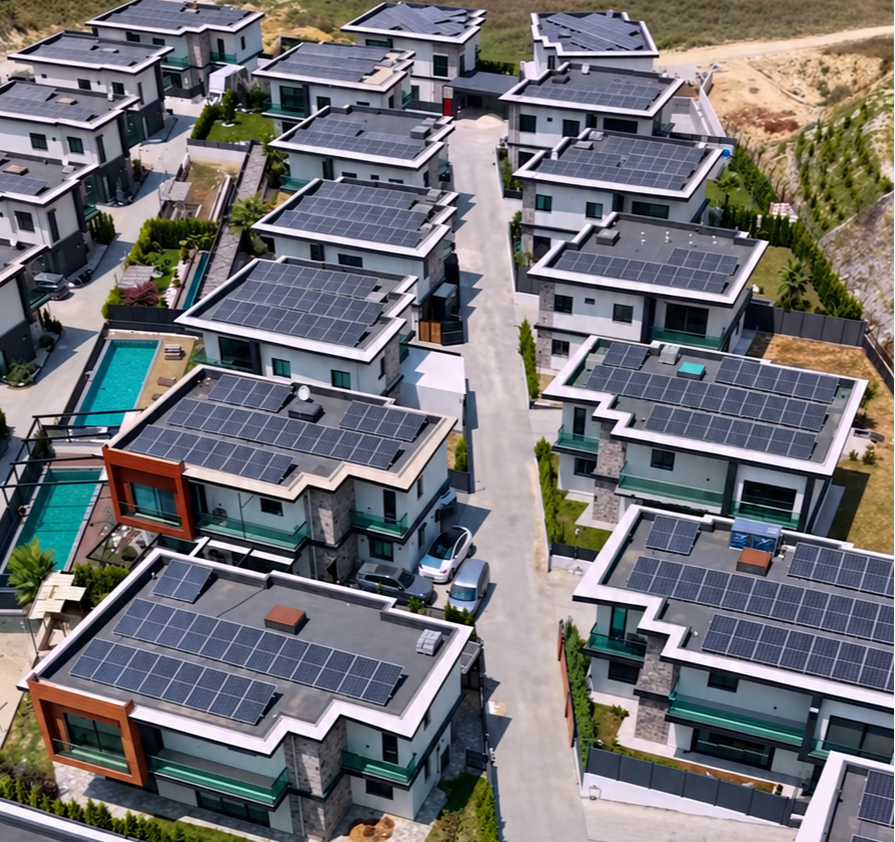 Residential · villa community


Inside the panel
A bifacial (double-sided) panel captures sunlight on its front and light reflected off the ground and roof on its back. It is made up of seven parts. Scroll down to separate the panel into its layers.
Sample panel: N-type TOPCon, bifacial dual-glass, half-cell, 1.13 × 1.72 m, aluminum frame.
30 yearslinear performance warranty
Toughened glass covers the front. An anti-reflective coating lets more light in; the glass protects the cells from hail and impact.
A transparent film that bonds the cells to the glass. During lamination it melts with heat and wraps around the cells, keeping out moisture and vibration.
Half-cut monocrystalline silicon cells that turn light into electricity. Thin silver lines collect the current, and ribbons connect the cells together. Half-cut cells have lower internal losses and are less affected by partial shading.
The second encapsulation layer behind the cells. It secures the cells to the rear surface.
On a bifacial panel, the back is tempered glass too. Light reflected from the ground and roof also reaches the cells from behind; the extra yield depends on the ground color and mounting height. Dual glass protects the cells from both sides.
An anodized aluminum profile supports the panel and keeps it rigid. The corners are locked together with corner keys; the panel is attached to the mounting rail by this frame.
The box on the back houses the bypass diodes. Its two output cables connect to the neighboring panel with waterproof MC4 connectors.
The back is glass too: reflected light reaches the cells from behind. Positive and negative cables from the junction box connect in series to the next panel with MC4 connectors.
How many panels, which inverter, how much battery? During the site survey we look at your roof and your bill and decide together.
30 yearslinear performance warrantyUnder the terms published by TommaTech, dual-glass (G2G) bifacial panels carry a 25-year product + 30-year performance warranty, and standard TOPCon panels a 15-year product + 30-year performance warranty. Terms vary by model; we include the panel’s warranty certificate with our quote.
Lithium storage
Panels generate during the day; lithium storage carries that energy into the evening, through the night and into the moment the power goes out. We start every system design with storage.
Inside the battery
The lithium iron phosphate (LiFePO4) battery we install alongside the system is made up of these seven parts. Scroll down to take the battery apart.
Display model: TommaTech LV LFP lithium battery, 51.2 V · 100 Ah (16 cells × 3.2 V). The model used in your project is determined during the site survey.
LFPchemistry resistant to thermal runaway · cobalt-free
A painted steel cover that protects the internal components from impact and dust. Its label shows the chemistry, voltage and capacity.
The battery management system monitors each cell’s voltage, temperature and current. It cuts the circuit in case of overcharging, deep discharge or overheating, and balances the cells.
Copper busbars connect the cells in series. With 16 cells in series, you get 16 × 3.2 V = 51.2 V.
The cathode material is lithium iron phosphate (LiFePO4). A hard-cased prismatic cell; “blade” cells use the same chemistry. The phosphate structure does not readily release oxygen when heated, which makes LFP far more resistant to catching fire than NMC.
Fire-resistant chemistryPads that electrically insulate the cells from the casing, dampen vibration and keep space between the cells.
The steel casing that holds the cell block. Side handles are for carrying and rack mounting.
Positive and negative terminals, on/off switch, status lights and communication ports for the inverter (CAN / RS485, depending on the model).
Connection panel: terminals, switch and communication ports. The battery talks to the hybrid inverter through these ports; capacity is expanded by connecting multiple modules in parallel.
Abuse test · illustrative animation
A nail pierces the cell and causes a short circuit. LFP heats up but doesn’t catch fire; NMC can ignite.
Based on laboratory tests: ORNL, Journal of Energy Chemistry, 2021.
How much storage do you need? We look at your consumption and the appliances that must keep running during an outage, and size the capacity together.
LFPchemistry resistant to thermal runaway · cobalt-freeIn overheating and nail-penetration tests, LFP cells react much later and more calmly than NMC cells; in most tests they produce smoke rather than flames. Still, like any battery, they require proper installation, ventilation and BMS protection.
Products
From solar panels to hybrid inverters, and from lithium storage to EV charging and heat pumps. Contact us for pricing.
Solar energy
Storage and charging
Agriculture and mounting
Wingo Energy · EPC
We are an EPC (engineering, procurement, construction) company. We design the project, procure the equipment, and install and commission it on site.
The mounting structure is chosen by calculation. We test the structure in simulation software against snow, wind and seismic loads.
Our team
Before you goCall back
We review your bill and your roof, then size a system just for you. The site survey is free and comes with no obligation.We reply the same business day. The site survey is free and comes with no obligation.
We’ve received your request.
We’ll call you the same business day. The site survey is free and comes with no obligation.
Request code: